Auto claim file
FNOL intake, missing-information analysis, chronology, file notes, communications, diary dates and closure summary.
 Claims Portfolio
Ontario · Claims · Case Management · Client Service
A practical portfolio showing how I investigate issues, organize files, communicate clearly and keep work moving toward resolution.
Independent portfolio exercise. Fictional training scenarios created for portfolio demonstration. They do not represent an actual claimant, customer, employer, insurer, patient or claim.
Project 01 · Completed
A fictional rear-end collision at Oxford Street West and Wonderland Road in London, Ontario. The work focuses on intake, evidence gathering, documentation, communication and appropriate escalation—not unsupported coverage, legal or settlement decisions.
Read the complete case fileFNOL intake, missing-information analysis, chronology, file notes, communications, diary dates and closure summary.
A 12-file fictional queue ranked by urgency, customer impact, deadlines and next-best action.
Live formulas, status tracking, follow-up dates, conditional formatting and workload indicators.
Clear, empathetic responses to repair concerns and a rental-limit risk without overpromising outcomes.
A standardized diary system supported by an intake checklist and communication templates.
Detailed work sample · Part A
Role boundary: This simulation shows information gathering, documentation, customer updates and escalation. Coverage, fault, repair and payment conclusions remain with an authorized reviewer.
Maya reports that she was stopped westbound at a red traffic signal when another vehicle struck the rear of her Corolla. Emergency services reportedly attended and both vehicles were towed. At intake, the circumstances, damage, injuries and insurance information remained subject to verification.
Photos were generally consistent with the reported rear impact, but they did not independently establish vehicle safety, repairability, coverage or fault. The collision centre advised that the trunk could not be secured and the vehicle should not be operated before inspection.
“I understand why you are concerned about whether the vehicle should be repaired. The authorized assessment currently supports repair. I can document your concern and arrange review of any supplemental damage or new evidence, but I cannot promise that the outcome will change.”
Contact the customer proactively, explain the delay and remaining rental limit, establish a dated update and escalate transportation options before the limit is exhausted.
Outcome: Initial estimate $15,900; final authorized invoice $16,740 following supplemental damage review. Repair completed and the file was prepared for authorized administrative completion.
Evidence of work
Separate known facts from missing information; request photographs, driver details, police information and invoices.
Use chronology, diary dates, outstanding-item tracking and clear next actions so commitments are visible.
Acknowledge concerns, explain current information accurately and avoid promising an outcome outside the role.
Balance urgency, customer impact, deadlines and dependencies across a multi-file workload.
Workload simulation
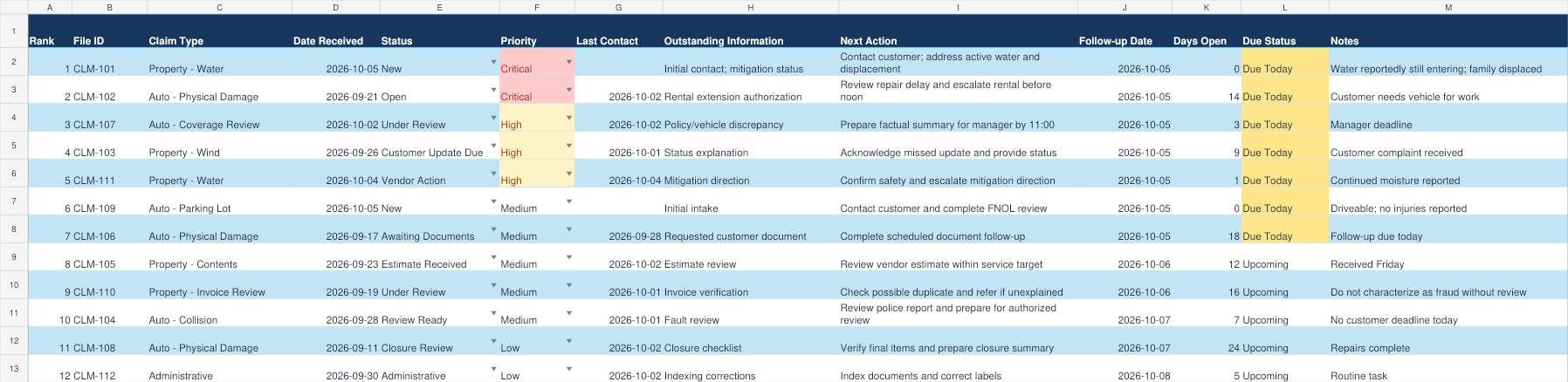
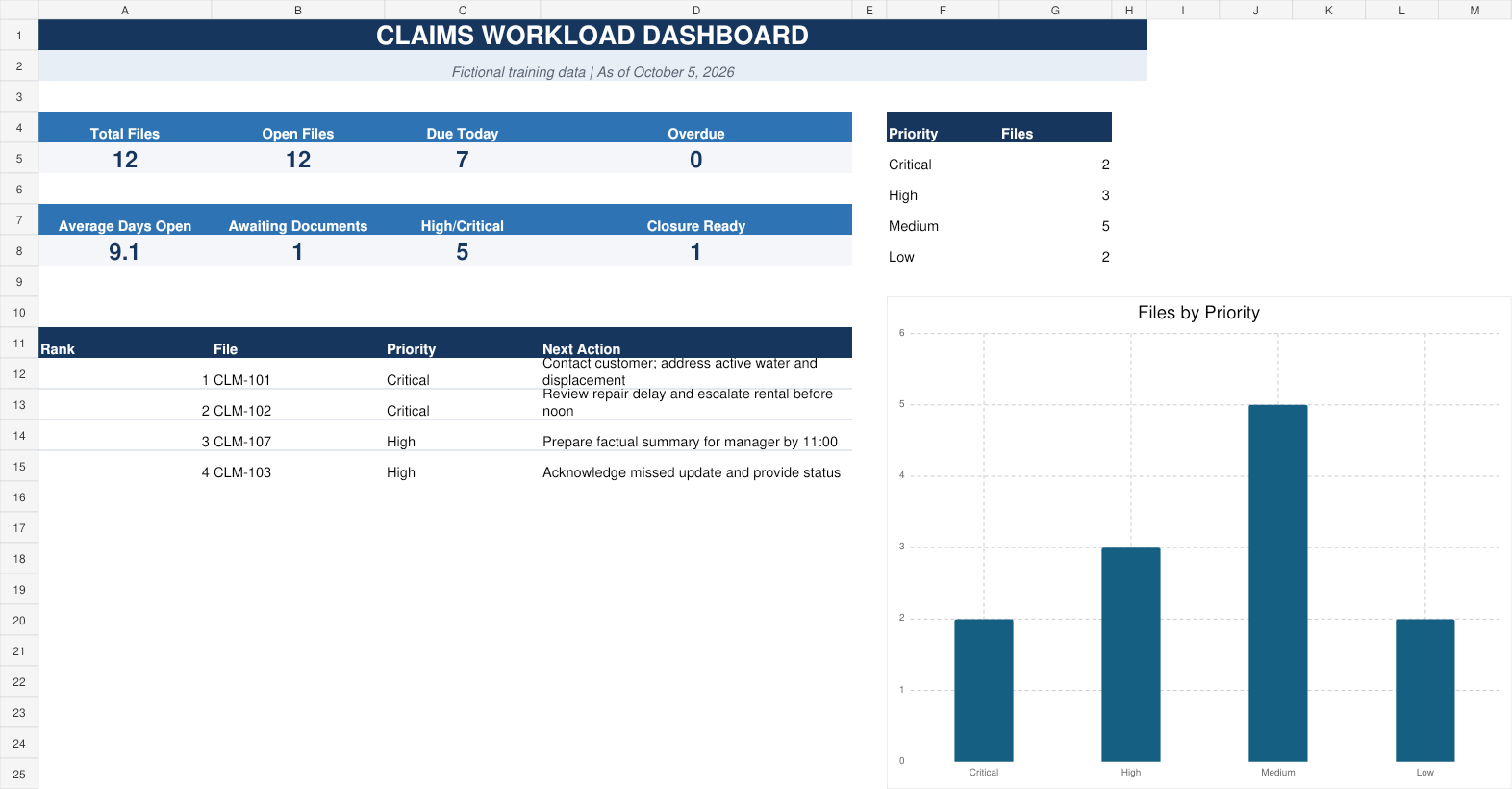
The tracker turns a mixed caseload into a manageable work plan. Numbers below come from a completely fictional 12-file training dataset.
| Order | File situation | Priority | Reason and next action |
|---|---|---|---|
| 1 | Active water loss | Critical | Prevent continuing damage; confirm mitigation and customer safety. |
| 2 | Rental limit approaching | High | Contact customer before transportation support may be interrupted. |
| 3 | Manager deadline | High | Complete the requested review and communicate any blocker. |
| 4 | Missed customer update | High | Restore communication and provide an accurate status. |
Tracks priority, status, customer contact, outstanding information, next action, follow-up date and days open.
 Click to enlarge
Summarizes open files, due and overdue follow-ups, status mix, claim types and average days open.
 Click to enlarge
Continuous improvement
The proposed improvement combines a standardized diary/follow-up tracker with an intake checklist and communication templates. It addresses missed commitments without removing the judgement needed for exceptional files.
Record required information and gaps at intake.
Assign an owner, next action and follow-up date.
Use consistent, accurate status updates.
Escalate overdue or high-impact items.
About
My background includes quality assurance, customer service, shift leadership and dental-office administration. This portfolio connects that experience to claims, case management and member-support work through transparent simulations.